You step off the plane in a new country, and the first thing you need is local money. The taxi driver only takes cash, the metro ticket machine rejects your card, and right there in arrivals sits a bright currency exchange booth offering to solve the problem. It feels like the easy answer. It is also, almost every time, the most expensive one.
Lose a few percent here and a few percent there, and by the end of a two-week trip you may have paid for an extra dinner without ever noticing. Getting a fair deal is simple once you know which methods to use and which single trap to avoid.
The Short Answer: The Best Way in Most Situations
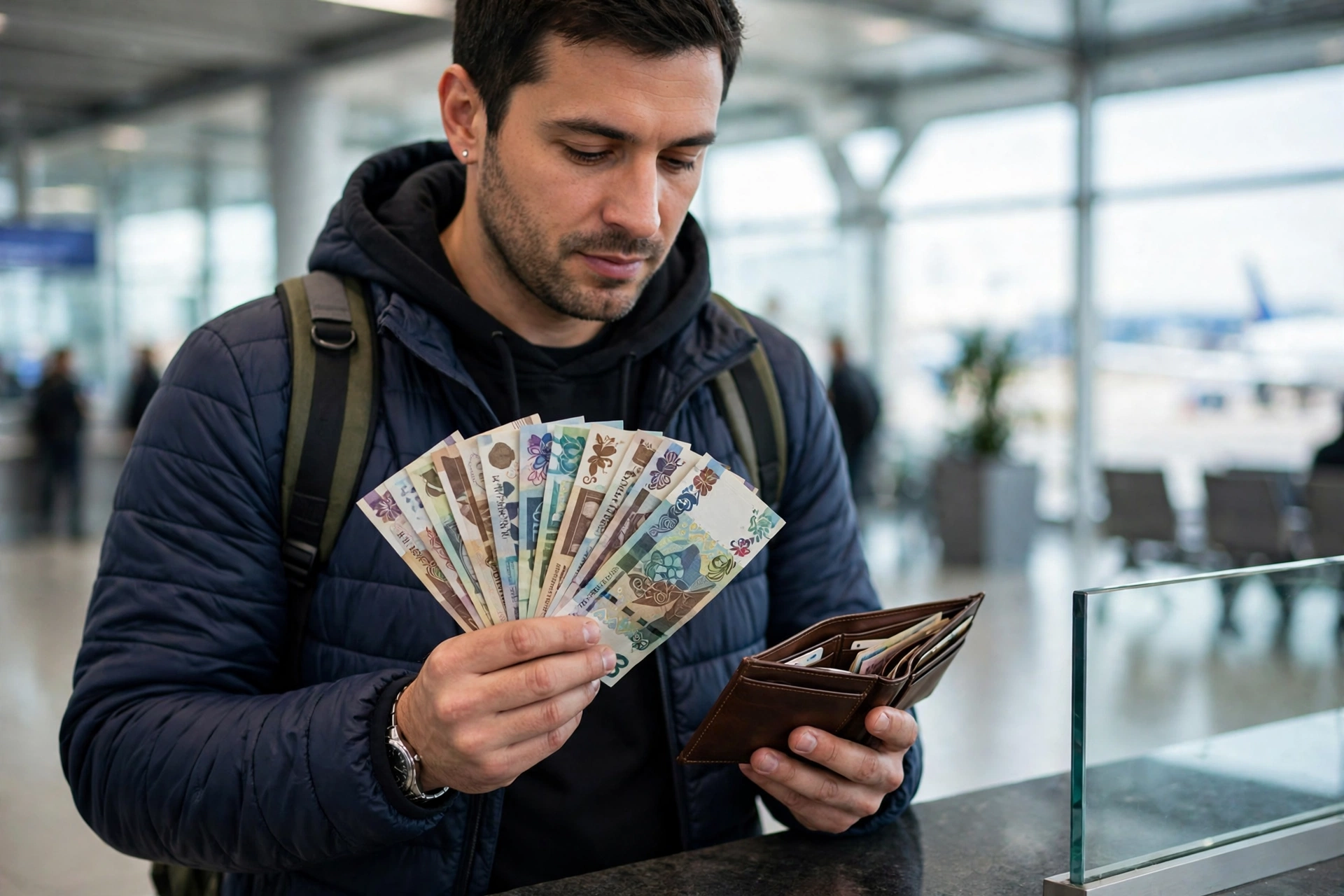
For most travelers, the best way to exchange currency when traveling abroad is a combination of two things: pay for purchases with a card that charges no foreign transaction fee, and withdraw local cash from an ATM attached to a real bank at your destination. Both convert money at rates very close to the mid-market rate, while physical exchange booths add their own markup on top.
If you only remember one rule, make it this one: never exchange a large amount of money at the airport, and never let a machine or a merchant convert a payment into your home currency for you.
Your Options, Ranked From Best to Worst
1. A No-Foreign-Transaction-Fee Card — Best for Purchases
When you pay by card, your card network converts the amount at a rate very close to the mid-market rate. If your card also charges no foreign transaction fee, that is about as cheap as exchanging money gets — often within about 1 percent of the true rate.
Check your card’s terms before you travel. Many standard credit cards add a foreign transaction fee of around 3 percent to every purchase abroad, which quietly erases the advantage. If your current card charges that fee, consider getting a travel card without one, and tell your bank your travel dates so a foreign charge does not trigger a fraud block.
2. A Bank ATM at Your Destination — Best for Cash
When you need physical cash, an ATM connected to a local bank is usually your best option. ATMs use the Visa or Mastercard network rate, which sits very close to the mid-market rate, and the total cost is typically far lower than any exchange counter. Use one on the wall of a real bank branch, ideally during banking hours, so you have somewhere to go if the machine keeps your card.
Two costs still apply. Your home bank may charge a flat fee per foreign withdrawal — a few dollars per transaction is common — and the local ATM operator may add its own surcharge. That is why it usually pays to withdraw a larger amount less often. Avoid standalone ATMs in tourist areas, malls, and convenience stores: they tend to charge the highest fees and offer the worst conversion options.
3. Ordering Cash From Your Home Bank — Decent for Arrival Cash
Ordering a small amount of local currency from your home bank before you fly covers your first taxi and meal without forcing you into an airport kiosk. Bank rates run a few percent above the mid-market rate — worse than an ATM, but far better than an airport booth.
4. A Local Exchange Counter in Town — Acceptable in a Pinch
A licensed counter away from the tourist center can work if you have no working card. Compare its rate with the mid-market rate on your phone first, and count your notes before you walk away. Counters advertising “no commission” usually make their money on a worse rate instead.
5. Airport Kiosks and Hotel Desks — The Worst Deal
Airport exchange booths are the most expensive option most travelers ever use. Travel guides commonly report that airport kiosks mark up their rates by roughly 7 to 15 percent above the mid-market rate, and many add a flat commission on top. The only exception is a late-night arrival when you need taxi cash and have no other option — then exchange only enough to reach your hotel.
The One Choice That Quietly Costs You the Most
The single most expensive habit in currency exchange has a name: dynamic currency conversion, or DCC. It happens when an ATM, a card terminal, or a hotel checkout offers to charge you in your home currency instead of the local currency. It sounds helpful, but the rate is set by the merchant’s payment processor, not your bank, and it usually includes a markup of roughly 3 to 8 percent.
The fix never changes: always choose to pay or withdraw in the local currency. If the screen asks whether to charge in your home currency or the local one, pick local. If a waiter has already selected your home currency without asking, ask them to void the transaction and run it again in the local currency.
How Much Cash Should You Actually Carry?
Most travelers carry too much cash, not too little. Cards are accepted almost everywhere in major cities now, and cash is mainly needed for taxis, street food, tips, and small shops. Keep one or two days’ worth of spending in cash, topping up from a bank ATM when you run low.
How you carry that cash matters as much as how much you carry. Split it between two places — some in your wallet and some in a separate pocket or your bag — so losing one does not leave you with nothing. For a fuller system, our guide on how to keep valuables safe while backpacking works just as well on a city trip.
Watch Out for Exchange Scams
Currency exchange attracts scams precisely because travelers are tired, rushed, and handling unfamiliar notes. The common ones: street dealers offering rates far better than any bank, booths that short-change you with quick hands, and counterfeit notes passed to visitors who do not know the real ones.
Stick to banks, bank ATMs, and licensed counters. Count your money in front of the teller, check the rate on your phone before the transaction, and walk away from anyone who pressures you to hurry. These are the same patterns covered in our guide on how to avoid tourist scams in a new city.
A Simple Plan for Your Next Trip
The whole process takes about fifteen minutes:
- Before you travel: confirm your card charges no foreign transaction fee, tell your bank your travel dates, and order a small amount of local currency for arrival day.
- On arrival: skip the airport exchange booth unless you have no other way to pay for transport. Use your card or the small cash you brought instead.
- For cash: withdraw from an ATM attached to a real bank, in larger amounts and less often, and always in the local currency.
- For purchases: pay by card wherever it is accepted, and always choose the local currency when the terminal asks.
- Before you leave: spend down your local coins and small notes, since coins are almost never exchangeable back home — and keep your last small bills for the airport.
FAQ
Should I exchange money before I travel?
A small amount, yes. Ordering some local currency from your home bank before you fly covers your first taxi and meal without forcing you into an airport kiosk. Exchange the bulk of your money at your destination, through bank ATMs and card payments, where the rates are better.
Can I just use US dollars abroad?
In a few heavily touristed places, some vendors accept dollars — but almost always at a poor rate they choose, not the real one. In most countries, dollars are not accepted at all outside airports and tourist shops. Local currency, by card or from an ATM, is cheaper and simpler nearly everywhere.
What if an ATM offers to convert the withdrawal into my home currency?
Decline it. That is dynamic currency conversion, and it adds a markup of roughly 3 to 8 percent on top of what your bank would charge. Always withdraw in the local currency and let your own bank do the conversion.
Final Thoughts
There is no secret trick to exchanging currency — just a short list of good habits. Pay by card when you can, use bank ATMs when you need cash, keep a little local money for arrival day, and never let anyone else choose the conversion rate for you. Do those four things and you will keep more of your travel budget for the trip itself.