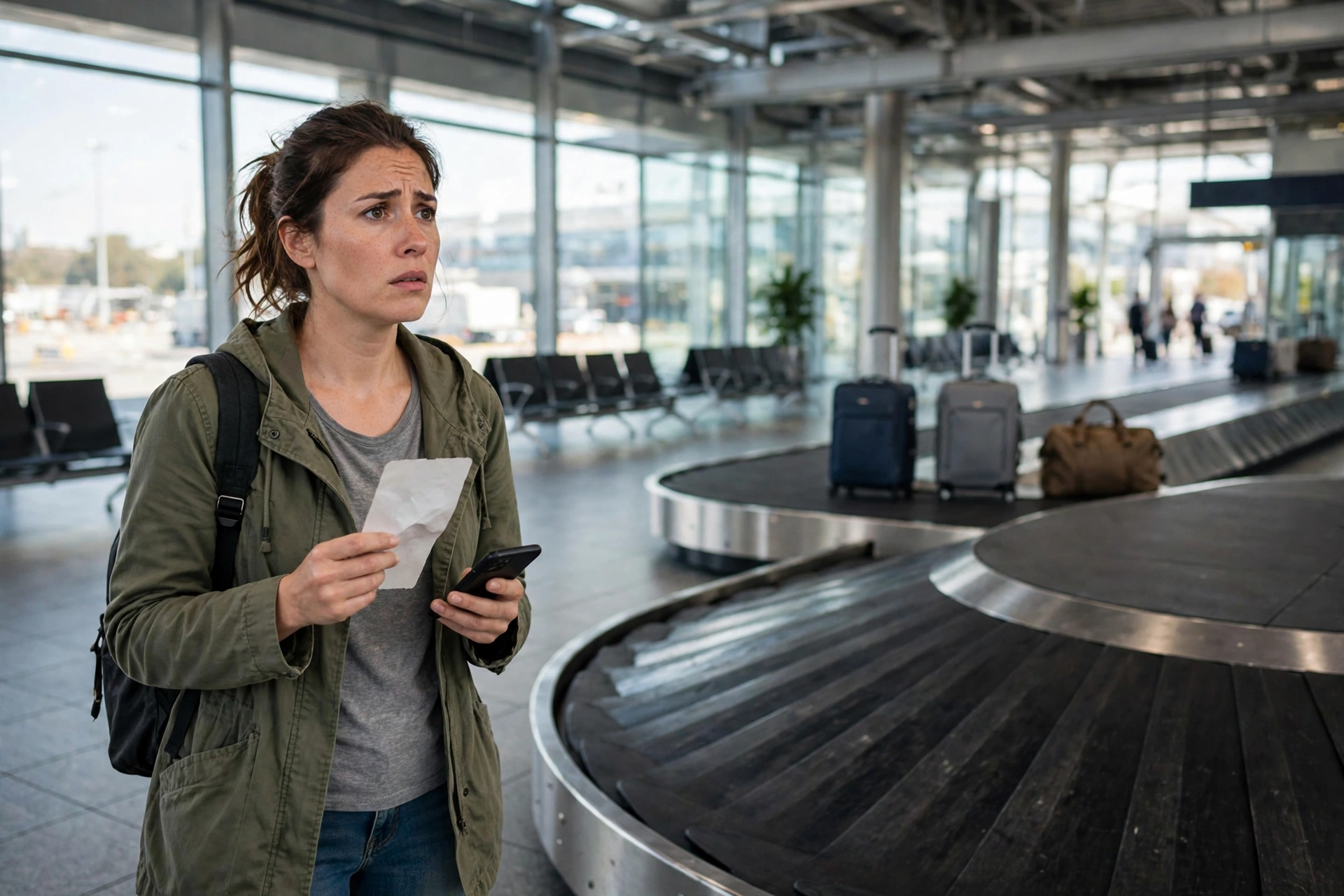
The belt keeps turning, the crowd thins out, and your suitcase never appears. One minute you are planning dinner at your hotel, and the next you are standing in a nearly empty baggage hall wondering what to do next. Lost luggage is stressful, but it is also a situation with a clear process, and the first hour matters more than anything that follows. This guide walks you through exactly what to do when your bag does not arrive, how to track it, what you can claim, and how to protect yourself if it never comes back.
Stay Calm and Check the Obvious First
Before you assume the worst, give the belt a few more minutes. Bags from a full flight can take 20 to 30 minutes to unload, and yours may simply be near the end of the queue. Check the flight number on the carousel display to make sure you are at the right belt. Oversized or fragile items, such as skis, golf clubs, and strollers, often arrive at a separate oversized-baggage area rather than the main belt. If the belt has stopped and your bag is still missing, it is time to act, not to wait.
Report It Before You Leave the Baggage Hall
Go straight to the airline’s baggage service desk, usually right beside the carousels, and file a Property Irregularity Report, known as a PIR. This is the official record that your bag did not arrive, and most airlines will not process a delayed or lost baggage claim without one. Do this before you leave the baggage hall: once you pass through customs and exit, you generally cannot return to the secure side without a new boarding pass. Get the PIR reference number in writing, on paper or by email, before you walk away. Every call, online check, and claim you make later will start with that number, so photograph it as a backup the moment you receive it.
What You Will Need at the Desk
The agent will ask for your boarding pass, the baggage claim tag stub from check-in, and a photo ID. You will also need to describe the bag itself: colour, brand, size, and any distinguishing marks such as a ribbon, sticker, or scuff. The more specific you are, the easier it is for staff to identify your bag when it turns up. Give the address where the bag should be delivered, usually your hotel, and a phone number where you can actually be reached during the trip. If you are travelling onward by train or bus, say so, and agree on how the airline will contact you.
Track Your Bag and Keep the Paper Trail
Most airlines use a shared tracing system called WorldTracer, and your PIR reference number lets you follow the search online. Check the status once or twice a day rather than every hour; the system updates when the bag is scanned at a new location, not in real time. If the status does not change for a day or two, call the airline and quote your reference number. Keep a short note of every call: the date, the name of the person you spoke to, and what they promised. Save every email and message from the airline in one folder. A clean paper trail is what turns a frustrating delay into a successful claim later.
Get Through the First Night Without Your Bag
A missing bag does not have to ruin your first day. Buy only the essentials you genuinely need: toiletries, a change of clothes, a phone charger, and any medication. Keep every receipt, because the airline will ask for them. Many airlines offer a daily allowance for essential purchases while a bag is delayed, but the amount and the rules vary by airline and route, so ask the baggage desk what your airline covers before you spend. If your medication was in the checked bag, contact a local pharmacy or doctor promptly rather than waiting. And for your next trip, think about packing a carry-on that covers your first 24 hours, so a delayed suitcase is an inconvenience instead of a crisis.
When a Delayed Bag Becomes a Lost Bag
Here is the reassuring part: most delayed bags are found and delivered within 24 to 72 hours. They usually went to the wrong flight or missed a tight connection, and the tracing system catches up with them. But if your bag has still not arrived 21 days after the date it should have been delivered, it can be treated as lost under the Montreal Convention, the treaty that governs most international flights. At that point you move from waiting for delivery to filing a full claim for the bag and its contents.
How Much Compensation Can You Claim
For international flights covered by the Montreal Convention, the airline’s liability for delayed, lost, or damaged checked baggage is capped at 1,519 Special Drawing Rights (SDR) per passenger. That limit was raised from 1,288 SDR on 28 December 2024, and at recent exchange rates it works out to roughly $2,000 to $2,100. The figure moves with exchange rates, so check the current value when you claim. Three things matter here: the limit is a ceiling, not an automatic payout; it applies per passenger, not per bag; and the same single limit covers delay, damage, and loss together, so money already paid for essentials counts toward it. You claim the actual value of what you lost, with receipts and an inventory to prove it.
For flights entirely within the United States, the Montreal Convention does not apply. Instead, the US Department of Transportation sets the maximum liability, which is currently $4,700 per passenger. Other countries set their own limits for domestic flights, so check the rules for the country where you are travelling.
How to File the Claim
Send your claim in writing, by email, as soon as the airline confirms the bag is lost or once 21 days have passed. Include your PIR reference number, baggage tag number, ticket details, and a detailed inventory of everything that was in the bag, with the value and approximate age of each item. Attach receipts or photos for higher-value items, and keep copies of everything you send. Deadlines are strict: under the Montreal Convention you must complain in writing within 7 days of receiving a damaged bag and within 21 days of a delayed bag being delivered to you, while a lost-bag claim must be brought within two years of the flight. If you are unsure what your bag contained, go through your packing list and trip photos; even a partial inventory is better than none. And remember that valuables and electronics belong in your cabin bag, not in checked luggage, so read up on how to keep your valuables safe while you travel before your next trip.
What If the Airline Says No or Offers Too Little
If the airline refuses your claim or offers far less than your proven loss, ask for the reason in writing, then escalate to the airline’s customer relations team, quoting your PIR number and attaching the same documents. If that fails, contact the aviation regulator in the country where the flight operated, such as the US Department of Transportation for flights to or from the United States, and check whether your travel insurance or credit card purchase protection covers lost baggage. Keep your tone factual and your documents organized; a calm, well-documented claim is far harder to dismiss than an angry phone call with no paperwork.
How to Make Lost Luggage Less Likely Next Time
You cannot eliminate the risk entirely, but you can shrink it. Photograph your bag and its contents before you check it in, so you can describe it precisely and prove what was inside. Make the bag easy to spot with a bright tag or ribbon, and remove old routing tags from previous trips so it is not sent to the wrong place. Keep your baggage tag stub until you are home. Put medication, chargers, a change of clothes, and anything irreplaceable in your cabin bag. A luggage tracker can tell you where the bag is even when the airline cannot. And where the schedule allows, choose direct flights or longer connections, since most misrouted bags are lost during tight transfers.
FAQ:
How long does it take for luggage to be considered lost?
Under the Montreal Convention, a bag that has not been delivered 21 days after the date it should have arrived can be treated as lost, and you can then file a full claim for the bag and its contents.
Will the airline deliver my delayed bag to my hotel?
In most cases, yes. Give the airline your hotel address and phone number when you file the report, and delivery is normally free. Confirm the arrangement at the baggage desk before you leave the airport.
Should I buy essentials while I wait?
Yes, but buy only what you genuinely need and keep every receipt. Many airlines reimburse reasonable essential purchases during a delay, up to the limits that apply to your flight.
What if my bag arrives damaged instead of lost?
Report it at the airport if you can, photograph the damage, and complain to the airline in writing within 7 days of receiving the bag. Keep the damaged bag and the tag until the claim is settled.
Final Thoughts
Standing at an empty carousel is a bad start to any trip, but it is not a helpless one. File the report before you leave the hall, keep your reference number safe, buy only the essentials and keep the receipts, and let the tracing system do its work. Most bags come back within a few days. If yours does not, the 21-day rule and the compensation limits give you a clear path to a fair claim. The best protection, though, is what you do before you fly: a photographed bag, a smart carry-on, and valuables kept close. Next time, a missing suitcase will still be annoying, but it will not catch you unprepared.